
Mechanical Parking Systems vs Self-Driving Parking Buildings: Which Is Better for Urban Parking?
This article compares mechanical multi-level parking systems and self-driving parking buildings, analyzing their space efficiency, cost structure, and application scenarios to help determine the most suitable solution for urban parking needs.
As the number of cars in cities continues to grow, parking space shortages have become a common challenge for many cities. For developers, property managers, and urban planners, how to provide more parking spaces within limited land resources while balancing economy and user experience has become an important issue.
The two most common solutions currently on the market are mechanical parking garages and self-propelled parking garages. Both can increase parking capacity, but there are significant differences in space utilization, environmental performance, operating costs, and user experience.
This article will take you through four dimensions to quickly understand the advantages and disadvantages of the two parking methods.
1. Space Utilization: Which Can Park More Cars on the Same Land?
For parking facilities, land is often the most expensive cost.
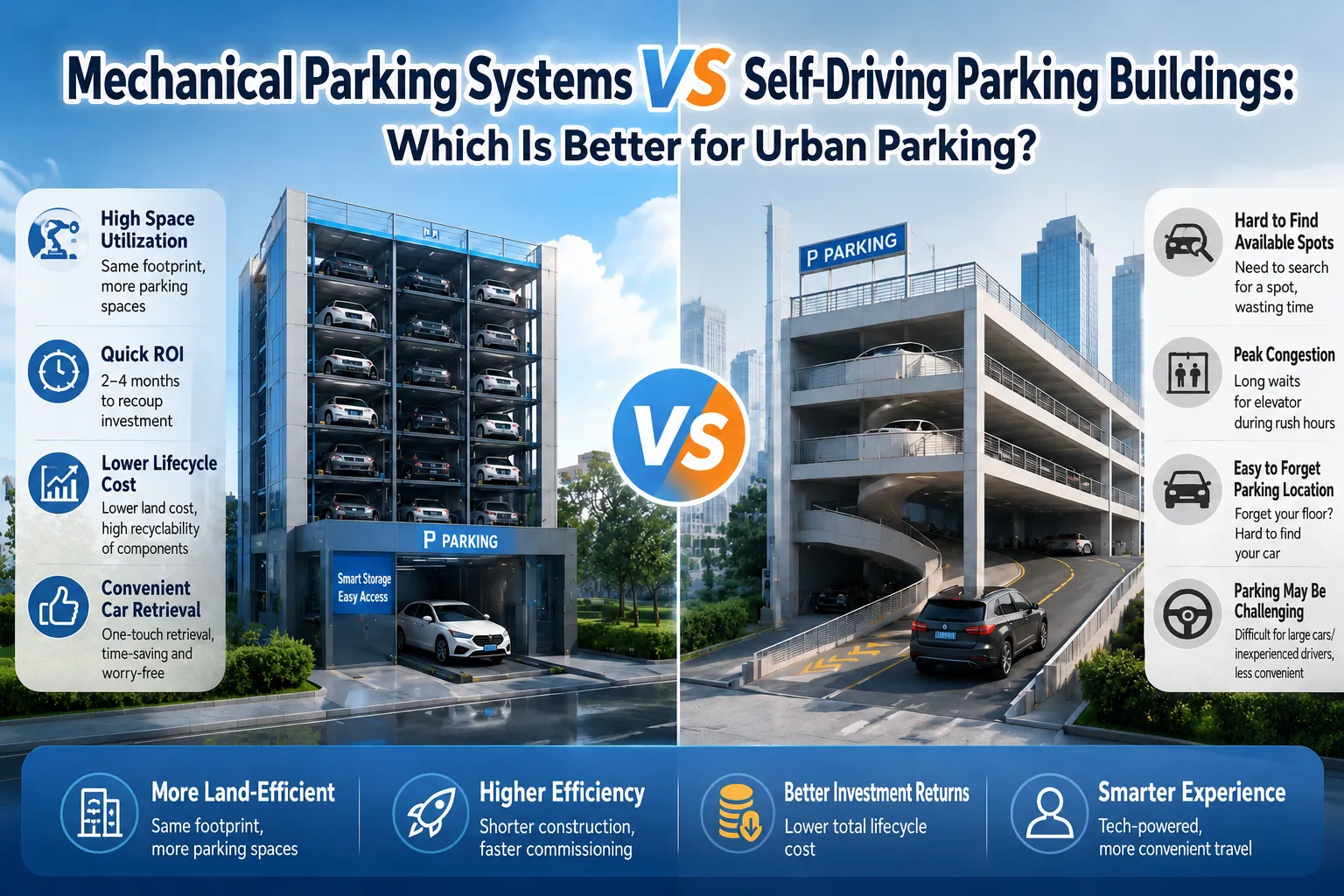
The working logic of a self-propelled parking garage is very simple: the driver drives into the parking garage, reaches each floor via ramps, and then finds an empty parking space to park. Although this mode is intuitive to operate, it takes up a lot of space. In addition to the parking space itself, it is necessary to reserve: driveways, turning areas, ramps, emergency evacuation spaces, and pedestrian walkways. Therefore, a parking space typically requires 30-35 sqm of building area.
In contrast, mechanical parking garages are completely different. After the vehicle enters the parking entrance, it can be turned off, and then the mechanical equipment automatically completes lifting, traversing, or transporting. Since there is no need for: vehicle ramps, large passageways, and driver activity space, the unit parking space area is greatly reduced, typically only 15-20 sqm, and some types even require only 1-2 sqm under certain circumstances (taking vertical lifting as an example).
On the same land area, mechanical parking garages can often increase parking capacity by 50% or even more than 100%. This advantage is particularly prominent for commercial centers, hospitals, residential areas, and old city renovation projects.
2. Construction Period: How to Quickly Put into Use?
The construction period of a parking project directly determines the speed of commissioning, the payback cycle, and the efficiency of benefiting the people. Especially for renovation projects, business districts and communities that urgently need additional parking spaces, the construction period is a key indicator. The difference in construction pace between the two modes is very obvious.
Self-propelled parking garages are complete civil engineering projects, mainly using reinforced concrete cast-in-place structures. The construction process is cumbersome, requiring excavation, foundation pouring, main structure construction, ramp construction, floor curing, fire protection and ventilation systems, and exterior facade construction. The overall construction period is long and greatly affected by weather, foundation pit curing, and fire inspection standards. A multi-story self-propelled parking garage typically takes 6-10 months for construction and acceptance, and large-scale projects may even exceed one year, resulting in slow implementation.
Mechanical parking garages use a steel structure modular prefabrication + on-site assembly mode. Most components are produced in standardized prefabrication in factories. On-site work only requires foundation cushion, steel structure erection, equipment assembly, and commissioning and acceptance. The civil engineering workload is minimal and not constrained by long curing processes. A typical hundred-space mechanical parking garage has an overall construction + commissioning and acceptance period of only 2-4 months, which is more than double the speed of the self-propelled type.
In addition, mechanical garages are suitable for renovation and expansion, as well as small plot transformation scenarios. They have minimal construction interference, controllable construction periods, can quickly fill the gap in parking spaces, achieve short-term implementation, rapid commissioning, and quick revenue generation. They are very suitable for projects that urgently need to solve parking problems and pursue fast, short-term results.
3. Economic Benefits: Which Offers Higher Investment Value?
Many people think that self-propelled parking garages are definitely cheaper. In fact, from a full lifecycle perspective, this is not the case.
1. Construction Cost: It's Not Just About Construction Cost
From a purely equipment perspective, the per-space equipment investment for mechanical parking garages is usually higher than that for ordinary parking garages, but it should be noted that the largest cost of a parking project is often not the equipment, but the land.
For example:
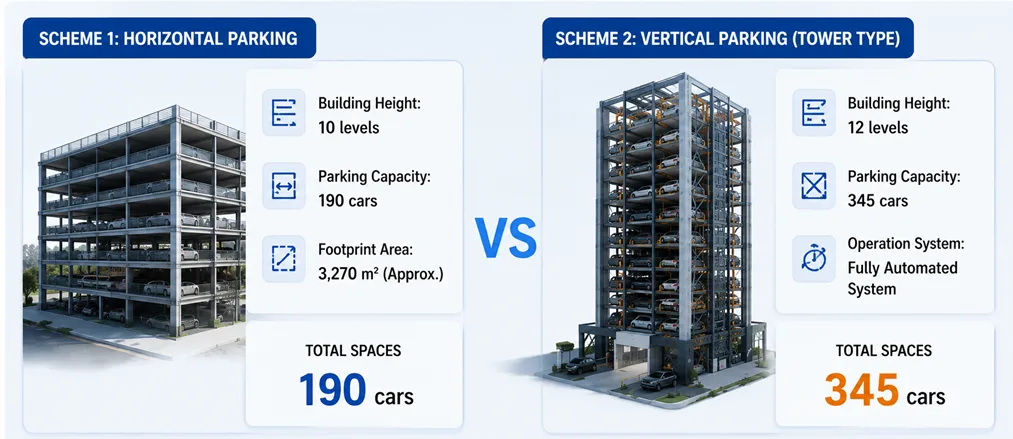
In a high-tech park in Suzhou, where land value is very high, a piece of land for building a parking garage has an area of 800 sqm and a height limit of 30m. Let's do a calculation:
If built as a self-propelled parking garage: designed to have 10 floors, with a conventional standard of 30 sqm per space, 19 spaces per floor, a total of 190 spaces can be built.
If built as a mechanical parking garage: designed to have 12 floors, with 5 groups of vertical lifting large cabins, each group having 69 spaces, a total of 345 spaces can be built.
Then, after the land cost is allocated to each parking space, the mechanical garage actually has an advantage.
Residual Value: Recyclable Salvage Value
In addition, people often overlook the residual value of the garage after it has served its purpose and reached the end of its service life.
Self-propelled parking garages are made of reinforced concrete and have almost no recovery value. When renovated or demolished later, a large amount of construction waste is generated, and additional costs for removal and disposal are incurred.
In contrast, mechanical parking garages are mainly steel structures. The materials can be disassembled, relocated, and reused. Both the equipment and the steel structure have considerable residual value. During later renovations or relocations, part of the cost can be recovered.
4. Access Efficiency and Experience: Which Makes Car Owners More Satisfied?
For users, the parking experience is often more important than the technology itself.
The parking process of a self-propelled parking garage is usually: drive into the garage → find a suitable parking space → park yourself → leave. When picking up the car: find the vehicle → walk to the vehicle → drive out of the garage.
It seems simple, but these situations often occur: no empty spaces on lower floors when in a hurry, forgetting which floor the car is on when picking up, queuing for elevators during peak hours... Large SUVs and novice drivers may also face parking difficulties. The experience in these processes makes users feel frustrated.
The parking process of a mechanical parking garage becomes: enter the ground-level storage room → turn off the engine and get out → click to park. When picking up: enter the license plate number on the operation screen → the system automatically retrieves the car → drive away. Smart garages can even offer mobile phone reservation for pickup.
The entire process of parking and retrieving in a mechanical garage can be done automatically by the system. Users don't need to find a parking space themselves, drive up and down ramps, worry about scratches, or remember the parking location. They only need to arrive at the garage entrance at the reserved time to pick up their vehicle. This experience is undoubtedly satisfying.
5. Summary: AI and Big Data Empowerment, Smart Garages Reshape the Future of Cities
Overall comparison shows that traditional self-propelled parking garages have a single function, can only meet basic parking needs, have no digital expansion capability, and are passive urban facilities. In contrast, smart mechanical parking garages, in addition to advantages in space, construction period, and full-cycle cost, can deeply adapt to the needs of future smart city construction by relying on intelligence, big data, and AI algorithms.
It supports unattended, automatic scheduling, and intelligent billing for full-process smart operations, significantly reducing operation and maintenance costs. At the same time, it can collect real-time parking flow data, accurately feedback regional parking supply and demand through big data analysis, and provide a digital basis for urban traffic planning and facility layout.
With AI-based intelligent scheduling, the garage can dynamically allocate parking spaces, divert traffic during peak hours, and predict parking pressure, transforming static parking lots into dynamic regulation units of urban traffic. Under the trend of urban intensification and digitalization, smart mechanical garages can revitalize idle urban spaces and optimize traffic resource allocation.
In summary, traditional parking models lacking smart empowerment can no longer adapt to the trend of fine urban governance. AI-empowered smart mechanical garages are the core direction for future urban smart parking upgrades.
About the Author

Shay Chen
Marketing Manager at CoPARK. Dedicated to promoting automated parking solutions and building partnerships across global markets.