
The Global Mechanical Parking Industry Explained: Key Trends, Regions, and Top Companies
A comprehensive overview of the global mechanical parking industry, including its development history, regional market distribution, and leading manufacturers. This article analyzes key technologies and regional patterns shaping the evolution of smart parking systems worldwide.
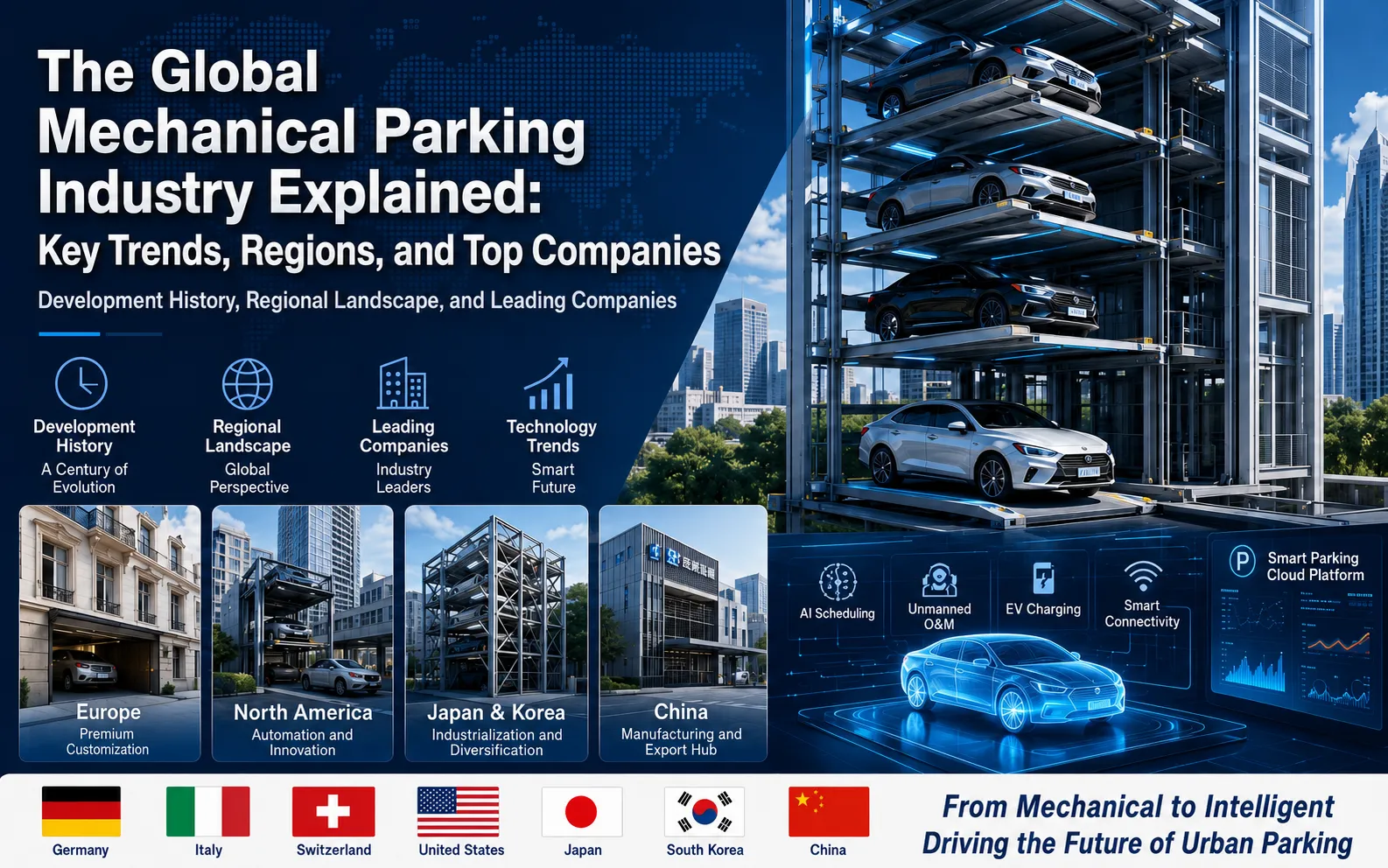
With global urbanization accelerating and car ownership rising, traditional flat parking lots occupy large areas with low utilization rates, leading to the rapid development of the mechanical parking industry. Nowadays, mechanical garages have integrated technologies such as automatic control, intelligent scheduling, AGV robots, and new energy charging, forming differentiated technical routes across various regions of the world. This article reviews the development history, major national technical routes, and leading suppliers of global mechanical parking. (Mechanical parking in this article broadly includes semi-automatic and fully automatic three-dimensional parking systems.)
I. Development History
Early exploration in Europe and America (1920s): In the early 20th century, early mechanical parking devices began to appear in the United States and Europe. In the 1920s, representative mechanical three-dimensional parking facilities emerged in Chicago. Germany, leveraging its industrial base, gave birth to high-end companies such as Wöhr and Klaus.
Japan's industrialization starting point (1950s-1980s): Due to land scarcity, Japan developed classic models such as tower garages and lift-and-slide systems. Companies like Nissei, ShinMaywa, and IHI established the globally universal technical architecture.
European high-end customization: Focusing on historical urban area renovation, emphasizing the integration of mechanical parking with architectural aesthetics, following a route of high-end customization and concealed parking.
US lag and transformation: Due to relatively abundant land, mechanical parking lagged for a long time. In recent years, high-density cities have shifted towards robot parking and smart parking software.
China's rise (1990s to present): It has gone through three stages: technology introduction, real estate-driven growth, and intelligent transformation. Currently, it is the world's largest producer and application market for mechanical parking, with advantages across the entire industrial chain.
II. Global Landscape and Representative Enterprises
Europe: High-end and Precision
Germany Wöhr: One of the oldest mechanical parking companies globally, specializing in flat slides, tower garages, and underground concealed garages, particularly skilled in high-end projects that maintain building façade integrity.
Germany Klaus Multiparking: Started with double/multi-level lifts and semi-automatic parking, expanded to large commercial and high-end residential automatic parking systems.
Italy Parkplus: Founded in 1997, focusing on high-end mechanical and fully automatic smart garages, a benchmark for high customization in small spaces in Europe.
Switzerland Sotefin: Founded in 1956, specializing in 'tray-less' fully automatic parking systems, representing the direction of high-end European engineering.
Germany Lodige Industries: Introduced industrial automation warehouse technology to mechanical parking, skilled in fully automatic parking, intelligent scheduling, high-rise tower garages, and airport projects.
North America: Automation and Innovation
USA Westfalia Technologies: Views parking systems as automated warehouses, specializing in AGV robot parking and aisle stacker garages, using intelligent scheduling software for unmanned retrieval.
Unitronics (Israeli background, deeply rooted in North American market): Famous for vertical parking towers and fully automatic vehicle retrieval technology, one of the most active fully automatic parking service providers in North America.
USA CityLift Parking: Focuses on small to medium-sized projects, modular design, and rapid installation, improving urban space utilization.
USA Automotion Parking Systems: Technology pioneer in the North American automatic parking industry, driving demand for smart cities and green buildings.
Japan and South Korea: Industrialization and Diversification
Japan IHI: Originating from a heavy industry giant, pioneer in tower garage and large vertical lift garage technology, with experience in ultra-large tower garages and high-capacity automatic parking projects, a global high-end benchmark.
Japan ShinMaywa Industry (ShinMaywa): Over 50 years of history, established the classic technical route of lift-and-slide and multi-level parking, with technical solutions widely exported to China and Southeast Asia.
Japan Nissei (NISSEI): Founded in 1953, an important founder of lift-and-slide, horizontal circulation, and elevator-type parking in Asia, known for high reliability, with extremely high adoption in Japan and Southeast Asia.
South Korea DongYang Parking: Provides tower, translation lift, and vertical circulation types, suitable for commercial buildings, residential, and public facilities.
South Korea TaeChang: Over 20 years of experience, emphasizing engineering design + automation control + non-standard project adaptation capability.
South Korea LOTTE E&M: Leveraging large-scale commercial real estate and urban complex resources, it is both a parking system supplier and a large parking lot operator.
South Korea LG: In 1973, it was an early achiever of mass production of rotary mechanical parking equipment. Its product line covers the full series, deeply involved in large public buildings and commercial complexes, a high-end benchmark in South Korea.
China: Global Manufacturing and Export Core
Xizi Intelligent: Founded in 1997 in Hangzhou, it is a long-established enterprise in the industry with a complete R&D, production, and service system. Projects cover the whole country, with deep technical accumulation.
COWAIN: Nantong Keruien Intelligent Equipment Co., Ltd., an emerging player in the industry with outstanding intelligent support capabilities and a full range of three-dimensional garage products. Focusing on highly intelligent parking, it leads in AI scheduling, unattended operation, and remote maintenance.
Yifeng: Shenzhen Yifeng, mainly deals with six series of parking equipment, highly known for AGV parking robots with comprehensive supporting facilities.
Dayang Parking: Weifang, Shandong, a leading company in northern China with strong production capacity, rich product line, deeply involved in national standard formulation, and can be equipped with new energy charging.
Tangshan Tongbao: Tangshan, Hebei, with many years of experience, complete qualifications, business covering domestic and export, rich practical project experience.
Jiulu: Jinan, Shandong, founded in 2015, a national-level specialized and new 'little giant', focusing on vertical circulation garages, compatible with integrated smart charging.
III. Conclusion
Germany laid the foundation of precision, Japan achieved industrialization and popularization, Europe established high-end customization standards, the US explored smart parking, and China grew into a global manufacturing and export core. Future industry competition will shift from hardware to intelligent software, system integration, and overall solutions, upgrading towards unmanned operation and maintenance, AI scheduling, new energy charging, and smart city interconnection. AGV robot parking and cloud-based intelligent management will become the mainstream direction.
About the Author

Shay Chen
Marketing Manager at CoPARK. Dedicated to promoting automated parking solutions and building partnerships across global markets.