
The Evolution of Mechanical Parking Systems: From “Functional” to “User-Friendly” System Optimization Solutions
The development of mechanical parking garages is not only about improvements in structure, transmission, and control systems, but also a shift in service philosophy. This article explores how the industry is evolving from simply increasing parking capacity to delivering efficiency, user experience, and long-term value through smart and user-friendly solutions.

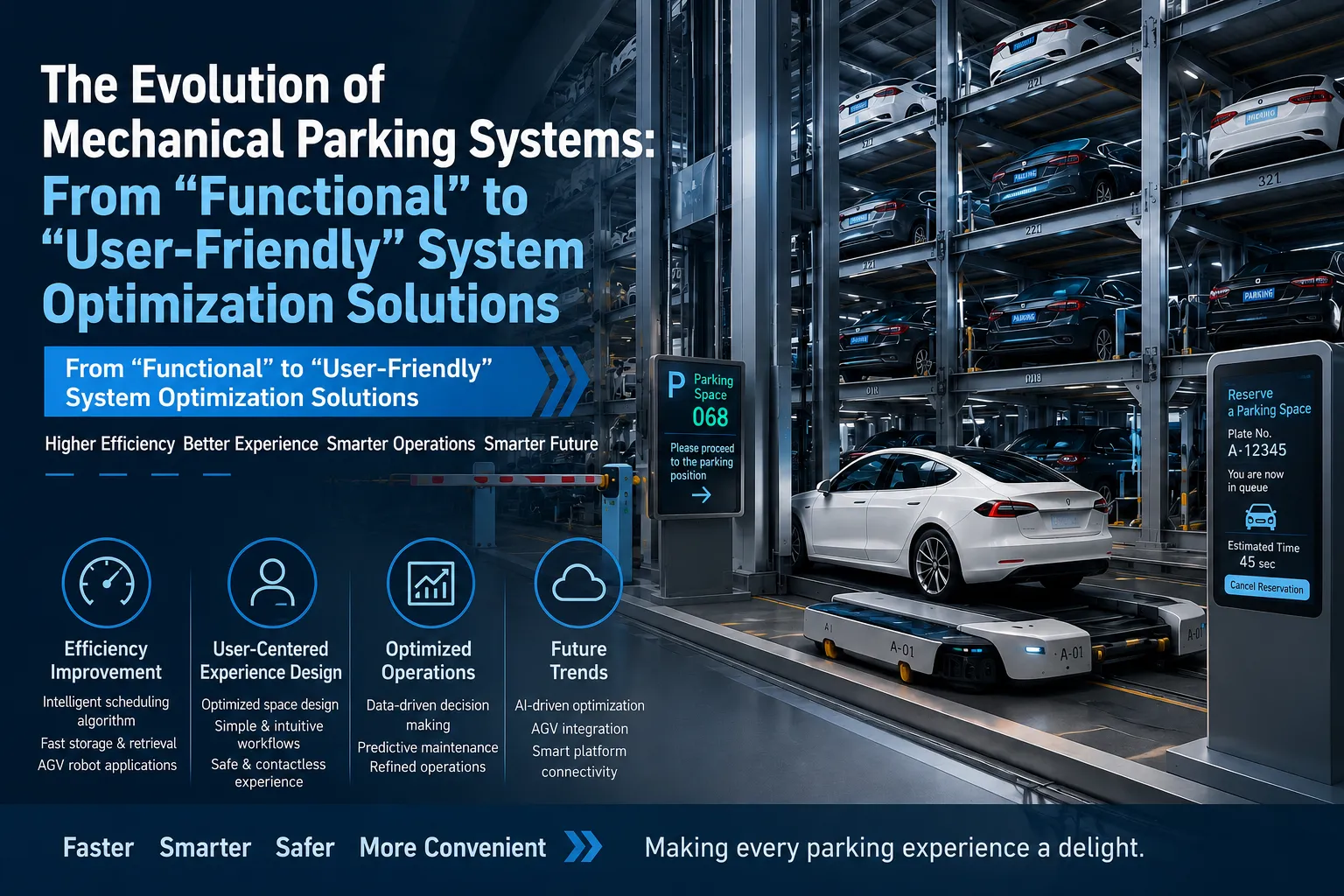
Over the past three decades, the focus of mechanical parking garage development has revolved around "increasing the number of parking spaces." From the earliest simple lifting and traversing devices to large-scale plane moving systems and aisle stacking systems, the industry has continuously pursued higher volume ratios and greater parking capacity. However, as the urban parking dilemma gradually shifts from "whether there is parking" to "whether parking is easy to use," new issues have emerged: long waiting times, low retrieval efficiency, high user learning costs, and high equipment idleness. The competitive focus of mechanical parking garages is shifting from "space utilization" to "user experience," which is the true evolutionary direction of the industry moving from "functional" to "user-friendly."
1. Efficiency Improvement: Making Parking and Retrieval "Fast"
One of the biggest criticisms of mechanical parking garages is that they are "slow." Solving the efficiency problem cannot rely solely on replacing motors with faster ones; instead, it requires systematic optimization at three levels: planning, algorithm, and control.
1.1 Garage Layout and Equipment Selection – Choose the Right Type, Reduce Half the Congestion
Different site shapes should adapt to different garage types. Additionally, avoid "large entrance but small exit": no matter how wide the entrance is, if the turning space at the exit is insufficient, reversing and turning will become a bottleneck. In the design phase, at least one SUV's turning radius should be reserved.
1.2 Intelligent Scheduling Algorithms – Don't Let Parking Spots "Wait Idly"
Many garages use a "fill in order" allocation logic, which leads to a consequence: the empty spaces near the entrance and exit are always occupied by the first cars to arrive, while later cars are dispatched to the deepest spots.
A better approach is dynamic allocation: during peak hours, prioritize allocating spaces closest to the exit that do not require the same-row lift to change directions. Set morning peak hours (7:30-9:00) as "retrieval only" and evening peak hours (17:30-19:00) as "retrieval priority." For example, a commercial complex using a dynamic parking space allocation strategy prioritized short-term parked vehicles to areas near the exit, reducing the average retrieval time by about 20% to 30%.
1.3 Fast Storage and Retrieval Technology – From "People Waiting for Cars" to "Cars Waiting for People"
Variable frequency speed regulation + multi-machine parallelism: avoid single-carrier queuing. For example, in plane moving garages, two traversing trolleys are installed on each floor, decoupling the lift and the carrier.
Pre-scheduling mechanism: After the user requests vehicle retrieval via the app, the system automatically moves the target parking space to the transfer floor in advance. When the user reaches the garage entrance, the car is already waiting.
1.4 AGV Parking Robots: This is the Ultimate Solution
In recent years, AGV parking robots have gradually become a new choice for high-end parking projects. Unlike traditional mechanical garages that operate on fixed tracks, AGV robots can autonomously navigate, transport, and dynamically plan routes based on real-time available spaces.
Their advantages are mainly reflected in: flexible layout, higher space utilization, easier expansion and renovation, and a user experience closer to valet parking. However, AGV systems also impose higher requirements on software scheduling capabilities, network stability, and project investment scale.
2. User Experience Design: Making Car Owners "Willing, Confident, and Happy to Park"
Efficiency is the foundation, but experience is the differentiator. Many mechanical garages are not slow, but they are not user-friendly enough.
2.1 Spatial Design: Eliminate "Scratch Anxiety"
Optimize parking space sizes based on different vehicle models to improve adaptability and space utilization. Some spaces can be designated as large or special spaces. Install mirrors, colored guide lines, and infrared anti-collision light curtains at the entrance; when a vehicle deviates from the track, trigger an audible and visual alarm and pause the equipment.
2.2 Interaction Process: Simplify to "No Learning Required"
The operation interface uses large fonts, real-life illustrations, and supports both voice and text prompts. Users can request vehicle retrieval via the app with almost no waiting.
2.3 Safety Design and Seamless Experience
Users are reluctant to park not because they don't know how to use the system, but because they worry about scratches, falls, or equipment malfunctions. Through real-time monitoring, parking visualization, and vehicle location confirmation, users can feel at ease. The ideal mechanical garage process in the future will be seamless: automatic license plate recognition, automatic space allocation, mobile phone retrieval request, automatic payment – the entire process requires no more than three clicks.
3. Operations Management: The "Invisible" Efficiency Enhancers
No matter how good the equipment and design are, if operations lag behind, the experience will still decline. Operations are not just about repairs; they are the driving force for continuous optimization.
3.1 User Behavior Guidance and Management
Provide professional training for garage management and operating personnel to improve management standards. During peak hours in the morning and evening, assign guides to assist, reducing congestion and improving efficiency and customer experience.
3.2 Data-Driven Continuous Optimization
Regularly analyze data such as single storage/retrieval time, operation timeout rate, and equipment fault downtime, and adjust parking space allocation strategies or physical modifications accordingly.
3.3 Maintenance Assurance Mechanism and Predictive Maintenance
Perform regular repairs and maintenance; before winter, rainy seasons, and special weather, inspect equipment like drainage pumps and dehumidification fans. By monitoring motor current, lifting speed, vibration, and temperature, potential faults can be detected early, reducing downtime and operational costs.
4. Future Trends: Mechanical Garages Are Becoming Smart Parking Platforms
The future direction of mechanical garages is not only equipment upgrades but also digital transformation. Trends include: AI scheduling optimization, AGV robot普及, cloud-based operations and maintenance, and integration with smart city systems. Mechanical garages will no longer be just parking equipment but an important component of intelligent transportation infrastructure.
Conclusion: From "Mechanical Thinking" to "User Thinking"
The development of mechanical parking garages has never been just about upgrading steel structures, transmission systems, and control programs; it is also an upgrade of service concepts. When the industry begins to re-examine parking efficiency, operational experience, and value from the perspective of user needs, mechanical garages can truly move from "increasing parking spaces" to "creating value." From "functional" to "user-friendly," and then to "smart and user-friendly," this evolutionary path continues.