
A Complete Guide to 9 Types of Mechanical Parking Systems: Which One Is Right for Your Project?
Mechanical parking systems can be divided into nine main types based on their working principles. This article explains each type’s structure, application scenarios, and cost differences to help developers, investors, and property managers choose the most suitable solution for their project needs.

The parking difficulty has spawned a huge market for mechanical parking garages. However, faced with the wide variety of mechanical garage types on the market, many investors, developers, and property managers often struggle with choices: Which technology is the most mature? Which has the lowest investment cost? Which is most suitable for my site and budget?
In fact, according to working principles, mechanical parking equipment can be divided into nine categories. Today, we will sort them out at once from three dimensions: working principle, applicable scenarios, and investment cost, to help you find the most suitable solution.
Simple Lift Type
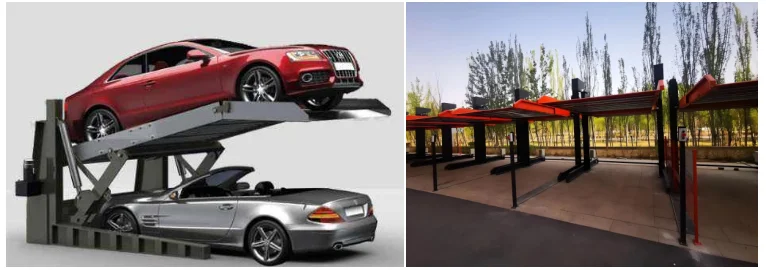
Working principle: This is the simplest type. A motor drives a chain to lift the pallet for parking and retrieval. It is a mechanical parking device that uses a lifting or tilting mechanism to park or retrieve a car.
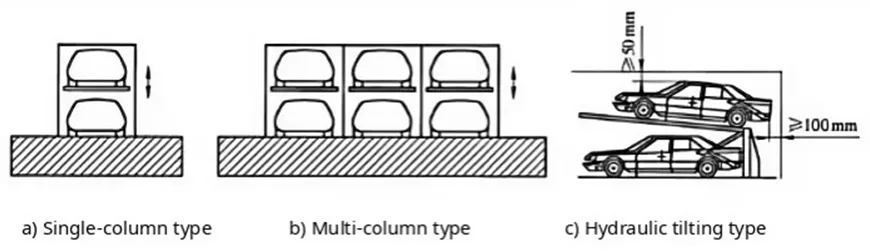
Product features: Known for 'safety and convenience', equipped with complete safety devices and control systems, simple structure, standardized design, mass production, fast installation, very mature operation.
1. Simple and practical structure, no special ground foundation requirements;
2. Single unit installation is easy and can be moved arbitrarily;
3. The equipment has a dedicated key switch to prevent unauthorized operation;
4. The upper pallet is equipped with an anti-slip safety device.
Applicable scenarios: Private villas, enterprise self-use parking lots, home dual parking space conversion.
Investment cost: Low. Simple structure, quick installation, an entry-level choice.
Lifting and Transfer Type (PUZZLE)
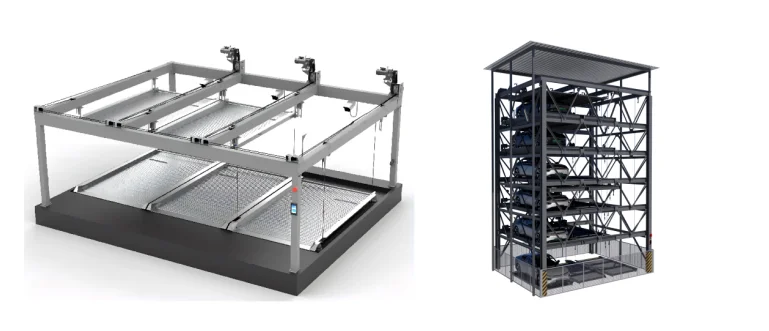
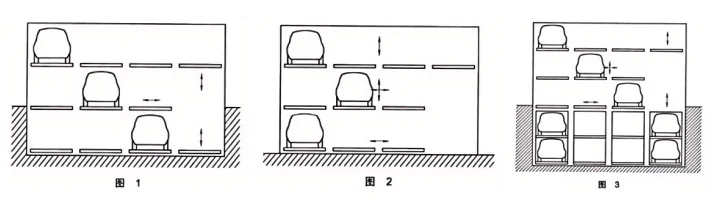
Working principle: Vehicles are parked or retrieved by lifting and transferring the pallet. It can be stacked in multiple layers. It is a mechanical parking device that uses pallets or other carriers to lift, lower, and transfer vehicles horizontally. Each parking space has a pallet. The pallet for the vehicle to be parked or retrieved moves to the ground level through lifting, lowering, and transferring. The top and bottom layers can only move up and down, not left or right; the intermediate layers can both lift and transfer. There is an empty space in the intermediate layers and the ground layer. By transferring the pallet to change the empty space, the pallet directly above the empty space can descend to the ground level to complete the process. Vehicles on the ground level pallets can be directly parked or retrieved.
Product features: The classic type with the highest market share.
1. Effective use of ground space, improving space utilization;
2. Quick and convenient parking, large-span beam design, barrier-free vehicle entry and exit;
3. PLC control, high degree of automation;
4. Energy-saving and environmentally friendly, low noise;
5. Harmonious human-machine interface, optional multiple operation modes, simple operation;
6. Average parking/retrieval time ≤ 90s.
Applicable scenarios: Renovation of old residential areas, small and medium-sized commercial facilities, public parking lots.
Investment cost: Medium-low. Extremely mature technology, controllable maintenance costs, the best value for money.
Planar Moving Type (SHUTTLE)
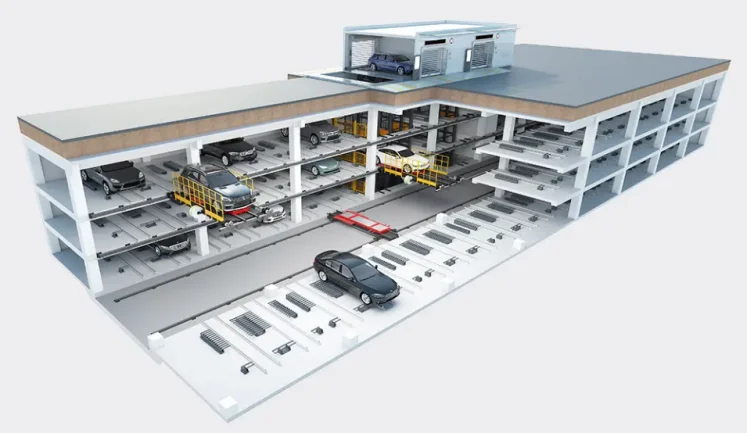
Working principle: On the same horizontal level, a transporter moves the vehicle to the designated parking space, often used in conjunction with a lift to achieve multi-layer automated parking.
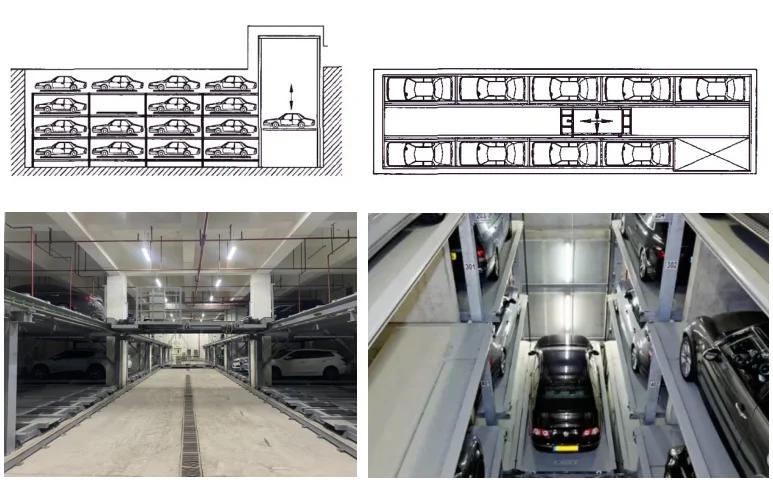
Product features:
1. Fully enclosed management, safe, theft-proof, providing optimal protection for vehicles;
2. Independent operation of trolleys and lifts on each floor, improving entry and exit speed;
3. Efficient use of underground space, parking capacity can reach thousands;
4. In case of failure in one area, normal operation of other areas is not affected;
5. Configuration of multiple lifts + walking trolleys on each floor allows multiple people to park/retrieve simultaneously.
Applicable scenarios: Medium to large underground/above-ground garages, large public buildings requiring high-density parking.
Investment cost: Medium-high. Higher degree of automation, better space utilization than lifting-transfer type.
Alley Stacking Type
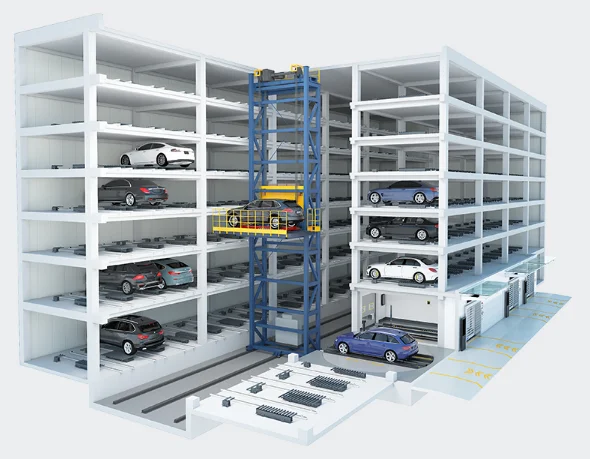
Working principle: Uses an alley stacker crane to move vehicles horizontally and vertically to the parking space, with a pick-up mechanism to park/retrieve cars.
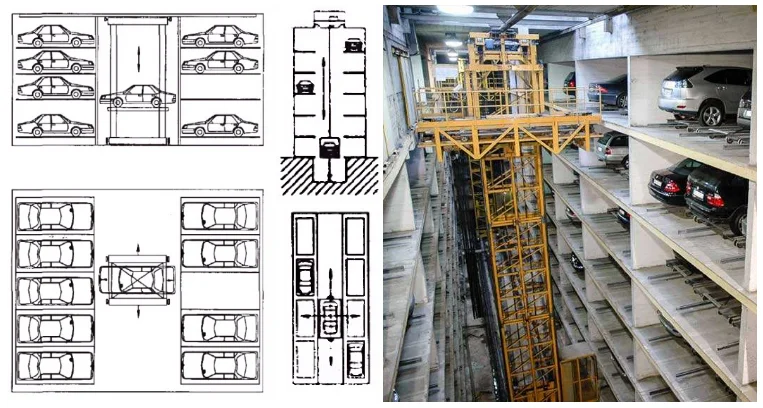
Product features: The entire parking/retrieval process is automatically completed by the system, safe and convenient.
1. Fully enclosed management, safe, theft-proof, providing optimal protection for vehicles;
2. Can be installed above or below ground, making full use of limited space;
3. Lifting and moving of pallets occur simultaneously, convenient and fast;
4. Only one stacker crane is needed in the alley, replacing multiple transfer trolleys and transporters, offering cost advantages;
5. Comprehensive management via computer and touchscreen interface, full monitoring of equipment status, simple operation.
Applicable scenarios: Large public parking buildings, professional parking lots in city centers.
Investment cost: High. Complex equipment, high requirements for civil engineering precision, suitable for high-capacity centralized projects.
Vertical Lifting Type (TOWER)
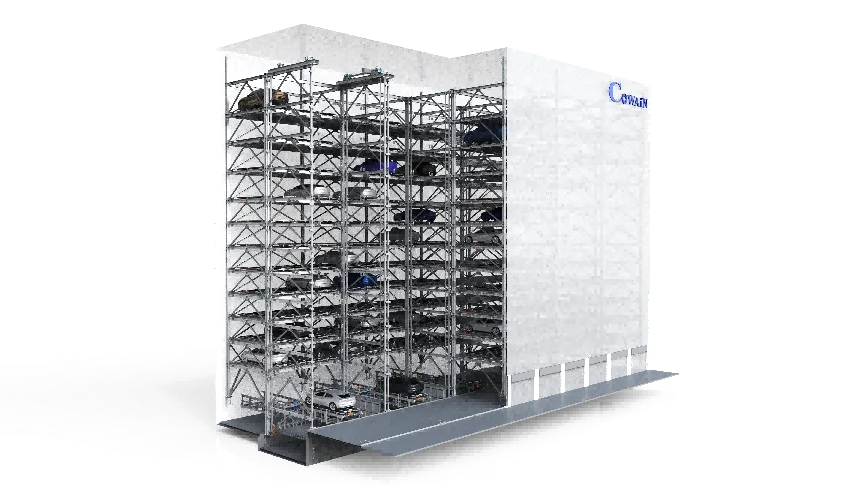
Working principle: Uses a lift to raise/lower vehicles to the designated floor, with a pick-up mechanism to park/retrieve cars. Similar to an elevator in principle and structure. Simply park the car at the entrance, and the car lift automatically lifts and moves it to the nearest empty space, completing the parking process.
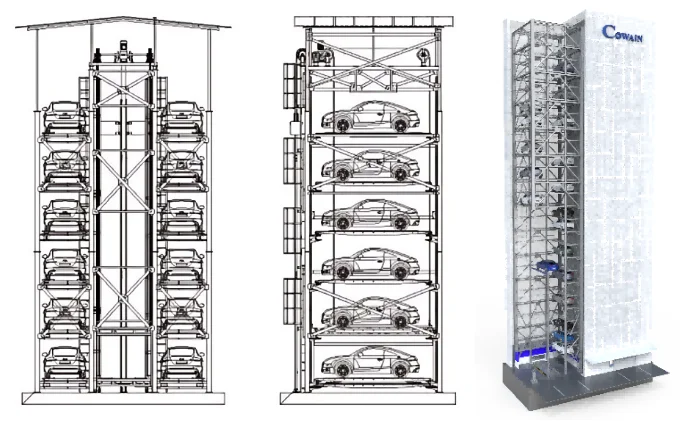
Product features: Commonly known as a 'tower garage'. A vertical lifting shaft in the center with multi-layer parking spaces radiating on both sides. Vehicles are delivered to designated spaces by a lift plus transfer mechanism.
1. Small footprint, large vehicle capacity; high-rise design can achieve an average of one square meter per vehicle;
2. Multiple sets of equipment in a row can provide multiple entrances/exits simultaneously, with simple and compact structure, fast operation, and short waiting time;
3. High degree of intelligence, supports app reservation for parking/retrieval and parking guidance;
4. The exterior decoration of the garage can be integrated with surrounding buildings, facilitating unified urban planning.
Applicable scenarios: Scattered small plots in city centers, prime commercial areas.
Investment cost: High. Extremely small footprint, highly integrated, representative of space utilization limits.
Vertical Circulation Type (ROTARY)
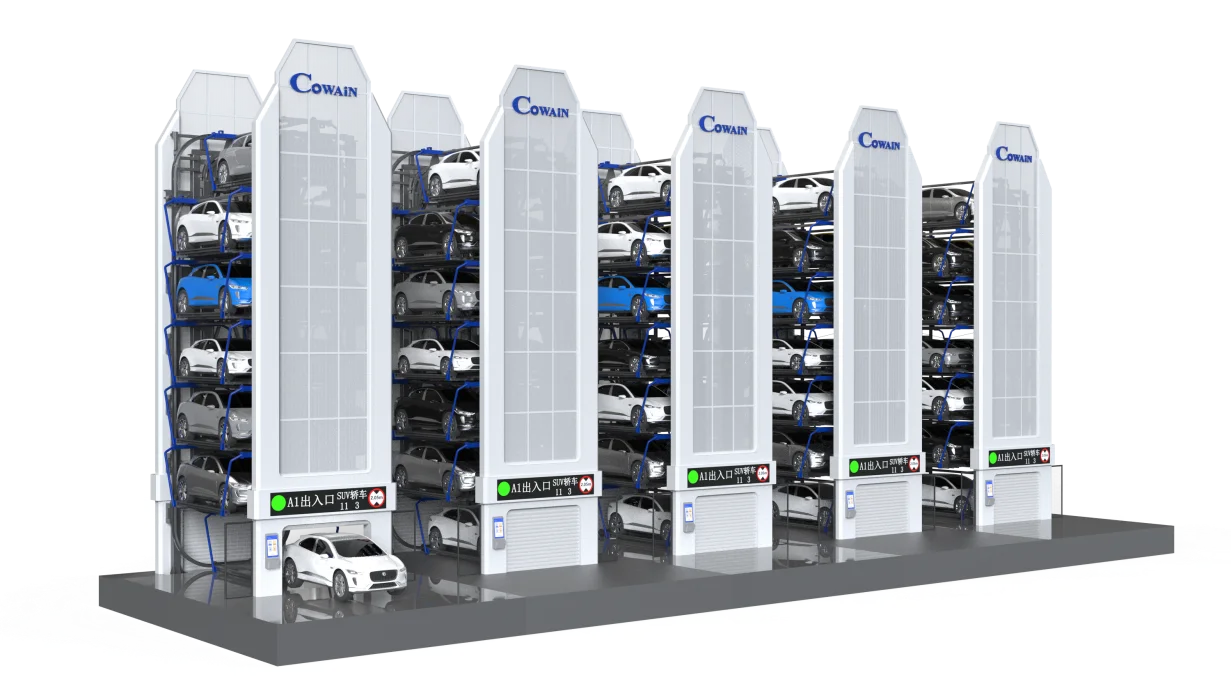
Working principle: The vertical circulation garage uses a motor with a reducer to drive the transmission mechanism. Pallet boards are installed at intervals on the chain. When the motor starts, the pallets move in a cycle along the chain, achieving parking/retrieval. Similar to a Ferris wheel principle, multiple basket-like pallets rotate vertically around a central axis, and vehicles are parked/retrieved through circular rotation.
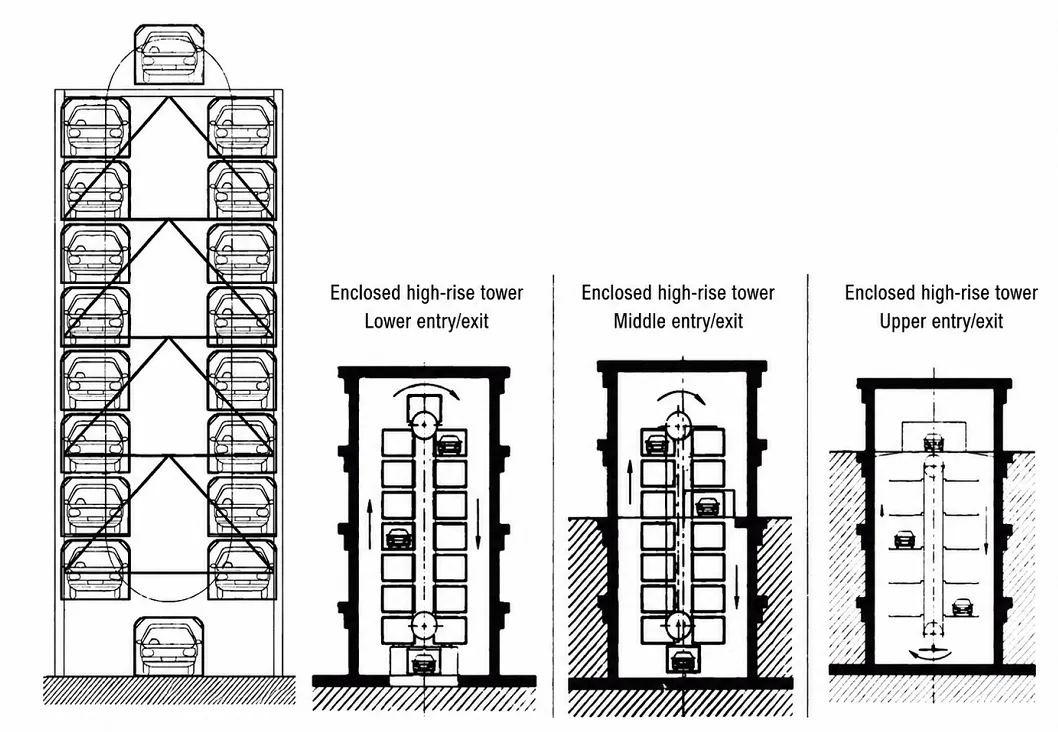
Product features:
1. PLC automatic dispatch, one button press completes parking/retrieval;
2. Can be installed on ground, semi-underground, independently or attached to buildings, and can combine multiple units;
3. High space utilization, saving significant land acquisition costs, facilitating rational planning and optimization of supporting buildings;
4. Equipment is often placed in outdoor open areas, generally no forced ventilation, pre-set fire pipes, no extensive lighting, power consumption only 35% of ordinary underground garages.
Applicable scenarios: Narrow roadside plots, small scattered land.
Investment cost: Medium. High degree of standardization, flexible layout, but waiting time for parking/retrieval.
Horizontal Circulation Type
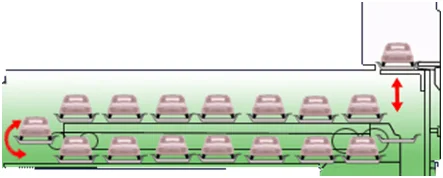
Working principle: Uses a horizontal circulation mechanism to move parking spaces horizontally to the lift or entrance/exit for parking/retrieval.
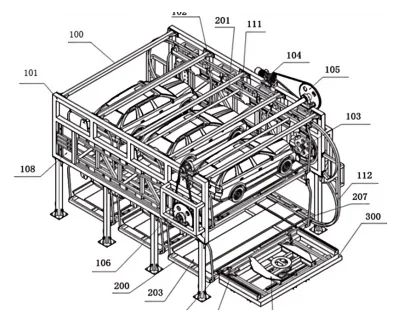
Product features:
1. Strong adaptability to spatial forms, suitable for 'narrow and long plots';
2. Compared to other types, lower civil engineering requirements, easy to retrofit inside existing buildings;
3. Clear parking/retrieval rhythm, multiple entries/exits can be set as needed to improve efficiency;
4. Automated parking/retrieval capability, users swipe card or press button at entrance/exit, system automatically dispatches spaces.
Applicable scenarios: Narrow and long plots, single-layer or small multi-layer automated garages.
Investment cost: Medium. Has some automation features but limited capacity.
Multi-layer Circulation Type
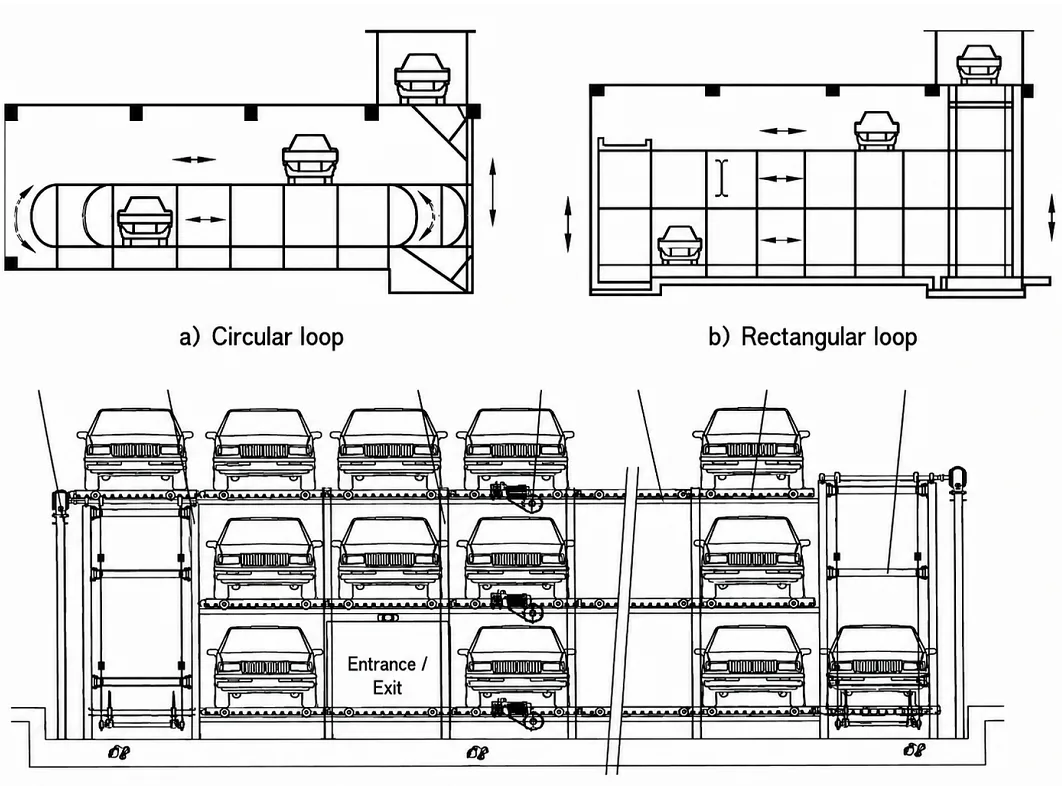
Working principle: Uses vertical circulation mechanisms or lifts to cycle vehicles between parking spaces on different floors for parking/retrieval.
Product features:
1. Vertical + horizontal composite circulation, realizing high-density three-dimensional parking, high space utilization;
2. Flexible track design according to terrain, more suitable for narrow and irregular spaces;
3. Fully enclosed automated operation, no personnel need to enter parking area;
4. Multiple entrances/exits can be set on different floors or directions, controllable efficiency.
Applicable scenarios: Special sites (e.g., deep underground narrow spaces, terrain-constrained areas).
Investment cost: Medium-high. Complex structure, a relatively special application.
Vehicle-specific Elevator
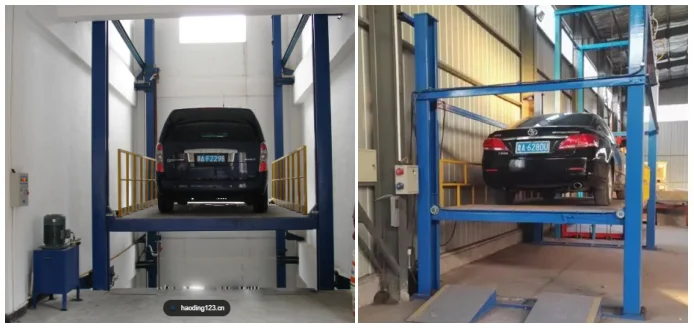
Working principle: Mechanical equipment for lifting and transporting vehicles from the garage entrance/exit to different parking floors.
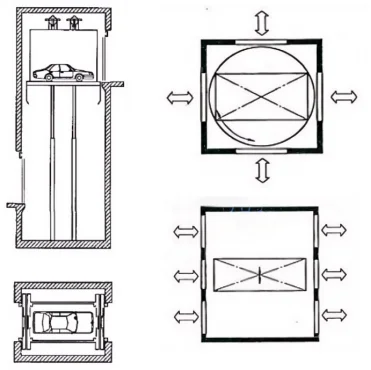
Product features: Specially used to vertically transport vehicles from the entrance to each parking floor. It does not store vehicles itself, only serves as a 'vertical transport tool'.
Applicable scenarios: Used in conjunction with various automated or semi-automated garages.
Investment cost: Medium. As the elevator part of the garage system, costs are accounted separately.
In summary: Sorting through the nine types, it is easy to see that the lifting-transfer type has been the mainstream due to mature technology, controllable costs, and strong adaptability. It is the first choice for renovation of old facilities and rigid demand. For modern commercial complexes, hospitals, and other scenarios that pursue ultimate experience and automated operation, intelligent solutions such as planar moving type, alley stacking type, and vertical lifting type represent the future of unattended and efficient turnover.
No matter what stage your project is in or how many budget constraints you face, among the nine types, there is always a path that precisely matches. The key is: not just choosing equipment, but choosing the right solution.